この商品を友人に教える:
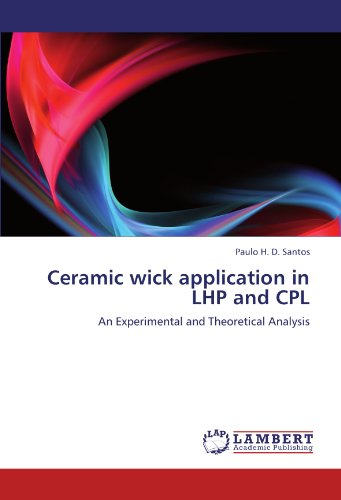
Ceramic Wick Application in Lhp and Cpl: an Experimental and Theoretical Analysis Paulo H. D. Santos
遠隔倉庫からの取り寄せ
 クリスマスプレゼントは1月31日まで返品可能です



Ceramic Wick Application in Lhp and Cpl: an Experimental and Theoretical Analysis
Paulo H. D. Santos
A ceramic porous wick is proposed in this book as an alternative to wicks made of sintered metal and plastic materials for applications in LHPs and CPLs. A theoretical and experimental analysis is presented. First, the heat and mass transfer in a flat capillary evaporator formed by a single or double-layered porous wick is analyzed. The wick has a shape of a flat disc and it is assembled between the liquid and vapor channels. An external heat input is applied in the upper surface of the wick, where the working fluid evaporates. The mass and heat transfer are modeled using the mass and energy macroscopic conservation equations. The models developed allow to verify the effect of design variables, such as working fluids, dimensions, permeability, average pore radius and thermal conductivity of the wick, in the performance of the capillary evaporator. For the experimental analysis, performance tests of two LHPs using acetone and water as working fluids were carried out for power inputs up to 25 W and performance tests of one CPL using water were carried out for power inputs up to 30 W.
| メディア | 書籍 Paperback Book (ソフトカバーで背表紙を接着した本) |
| リリース済み | 2012年7月19日 |
| ISBN13 | 9783659190797 |
| 出版社 | LAP LAMBERT Academic Publishing |
| ページ数 | 168 |
| 寸法 | 150 × 10 × 225 mm · 268 g |
| 言語 | ドイツ語 |