この商品を友人に教える:
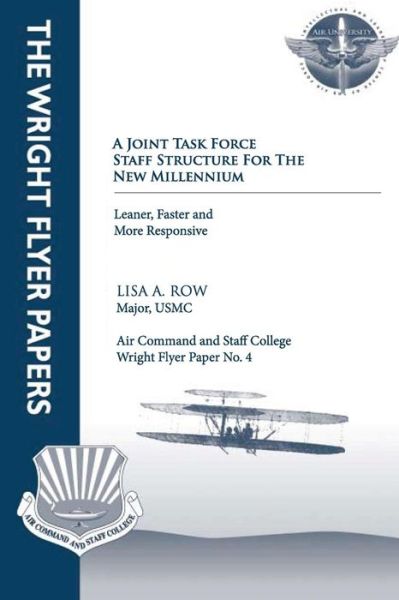
A Joint Task Force Staff Structure for the New Millennium - Leaner, Faster, and More Responsive: Wright Flyer Paper No. 4 Maj Lisa a Row
遠隔倉庫からの取り寄せ
 クリスマスプレゼントは1月31日まで返品可能です



A Joint Task Force Staff Structure for the New Millennium - Leaner, Faster, and More Responsive: Wright Flyer Paper No. 4
Maj Lisa a Row
Publisher Marketing: Our military future will likely be radically different from our past. Consequently, military personnel can prepare for this future by investigating ways to adapt to novel chal - lenges posed by new weapons, new theories, or new or - ganizations. This study explores the problem of how joint task force staffs should reorganize to improve future command and control to meet demands of the most likely future environ - ment. The research methodology consisted of a literature search from a broad body of evidence. Sources included business literature, studies by organizations such as the Center for Naval Analyses, and research papers produced by other students. Several key changes envisioned for the military provide a foundation for the project and introduce future opera - tional and environmental complexities. These changes include emerging international and national trends such as increased military operations other than war and growing military pressures to shrink but remain effective. Another trend, the "revolution in military affairs," includes such aspects as a "system of systems" and "dominant battle space awareness." Additionally, Joint Vision 2010 offers a conceptual view of future battle-space activities that are portrayed as markedly different from today's activities. Against this backdrop of change, two primary reasons for using military staffs-information management and decision making-open a path to the heart of the paper and serve as a frame of reference for new organizational de - signs. Two metaphors offer vivid conceptual staff images. First, the "spider plant" metaphor depicts a multifaceted organi - zation with a core structure and many outlying satellite organizations, illustrating the potential for semiautonomous operations. Second, the "brain" metaphor captures the essence of relationships between key organizational elements and shows natural applications of decentralized decision making. The study concludes with a discussion of benefits gained through reorganization: faster, more responsive operations and leaner structures. Both metaphors strive to define essential relationships between staff elements. The overarching theme involves finding areas where commanders and staffs can decentral - ize operations to improve speed and responsiveness. Often this decentralized approach is enabled by technology, how - ever, the leaders must first be willing to let go of their control and learn to live in a complex environment-near the edge of chaos. With a goal of stirring ideas for reorganization, this study applies contemporary vision statements and thoughts to command and control and related staff struc - tures. It demonstrates potential to improve operations by developing innovative ways to visualize staff interactions. The time has come to move beyond rhetoric about the future and to develop useful ways to prepare. This work provides one step along the path of innovation.
| メディア | 書籍 Paperback Book (ソフトカバーで背表紙を接着した本) |
| リリース済み | 2012年8月15日 |
| ISBN13 | 9781479202522 |
| 出版社 | Createspace |
| ページ数 | 48 |
| 寸法 | 152 × 229 × 3 mm · 77 g |