
この商品を友人に教える:
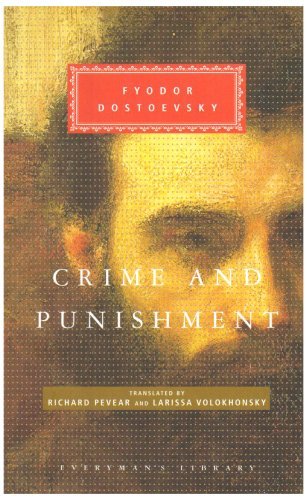
Crime and Punishment Fyodor Dostoevsky


他の形態でも入手可能:
-
Paperback BookReissue edition(1996) ¥ 1.854
- Hardcover Book (2023) ¥ 2.128
- Book (2026) ¥ 2.479
- Paperback Book (2017) ¥ 2.557
- Paperback Book (2025) ¥ 2.576
- Paperback Book (2017) ¥ 2.576
-
Hardcover BookDeluxe Hardbound edition(2022) ¥ 3.221
- Hardcover Book (2025) ¥ 3.396
- Paperback Book (2016) ¥ 3.474
- Paperback Book (2020) ¥ 3.689
- Paperback Book (2016) ¥ 3.767
- Paperback Book (2020) ¥ 3.826
- Paperback Book (2020) ¥ 3.826
- Paperback Book (2020) ¥ 3.826
- Paperback Book (2020) ¥ 3.826
- Paperback Book (2020) ¥ 3.826
- Paperback Book (2020) ¥ 3.826
- Paperback Book (2020) ¥ 3.826
- Paperback Book (2020) ¥ 3.826
- Paperback Book (2020) ¥ 3.826
- Paperback Book (2023) ¥ 3.845
- Paperback Book (2016) ¥ 3.865
- Paperback Book (2016) ¥ 3.904
- Paperback Book (2018) ¥ 4.001
- Paperback Book (2012) ¥ 4.138
Crime and Punishment
Fyodor Dostoevsky
Fyodor Dostoyevsky, in full Fyodor Mikhaylovich Dostoyevsky, Dostoyevsky also spelled Dostoevsky, (born November 11 [October 30, Old Style], 1821, Moscow, Russia-died February 9 [January 28, Old Style], 1881, St. Petersburg), Russian novelist and short-story writer whose psychological penetration into the darkest recesses of the human heart, together with his unsurpassed moments of illumination, had an immense influence on 20th-century fiction. Written at the same time as The Gambler, Prestupleniye i nakazaniye (1866; Crime and Punishment) describes a young intellectual, Raskolnikov, willing to gamble on ideas. He decides to solve all his problems at a stroke by murdering an old pawnbroker woman. Contradictory motives and theories all draw him to the crime. Utilitarian morality suggests that killing her is a positive good because her money could be used to help many others. On the other hand, Raskolnikov reasons that belief in good and evil is itself sheer prejudice, a mere relic of religion, and that, morally speaking, there is no such thing as crime. Nevertheless, Raskolnikov, despite his denial of morality, sympathizes with the unfortunate and so wants to kill the pawnbroker just because she is an oppressor of the weak. His most famous theory justifying murder divides the world into extraordinary people, such as Solon, Caesar, and Napoleon, and ordinary people, who simply serve to propagate the species. Extraordinary people, he theorizes, must have "the right to transgress," or progress would be impossible. Nothing could be further from Dostoyevsky's own morality, based on the infinite worth of each human soul, than this Napoleonic theory, which Dostoyevsky viewed as the real content of the intelligentsia's belief in its superior wisdom.
| メディア | 書籍 Paperback Book (ソフトカバーで背表紙を接着した本) |
| リリース済み | 2020年8月8日 |
| ISBN13 | 9798673615607 |
| ページ数 | 520 |
| 寸法 | 152 × 229 × 29 mm · 752 g |
| 言語 | 英語 |
Fyodor Dostoevskyの他の作品を見る
すべて表示










![Cover for Fyodor Dostoevsky · The Eternal Husband (Paperback Book) [Warbler Classics Annotated edition] (2022)](https://imusic.b-cdn.net/images/item/original/282/9781957240282.jpg?fyodor-dostoevsky-2022-the-eternal-husband-paperback-book&class=scaled&v=1649129281)

このシリーズの他の商品

![Cover for Fyodor Dostoevsky · Crime and Punishment: A Norton Critical Edition - Norton Critical Editions (Paperback Book) [Critical edition] (2018)](https://imusic.b-cdn.net/images/item/original/272/9780393264272.jpg?fyodor-dostoevsky-2018-crime-and-punishment-a-norton-critical-edition-norton-critical-editions-paperback-book&class=scaled&v=1549866186)
![Cover for Fyodor Dostoevsky · Crime and Punishment: Pevear & Volokhonsky Translation - Vintage Classics (Paperback Book) [Reprint edition] (1993)](https://imusic.b-cdn.net/images/item/original/505/9780679734505.jpg?fyodor-dostoevsky-1993-crime-and-punishment-pevear-volokhonsky-translation-vintage-classics-paperback-book&class=scaled&v=1408398319)


![Cover for Fyodor Dostoevsky · Crime and Punishment - Macmillan Collector's Library (Hardcover Book) [New edition] (2017)](https://imusic.b-cdn.net/images/item/original/749/9781509827749.jpg?fyodor-dostoevsky-2017-crime-and-punishment-macmillan-collector-s-library-hardcover-book&class=scaled&v=1486062590)

![Cover for Fyodor Dostoevsky · Crime and Punishment: With selected excerpts from the Notebooks for Crime and Punishment - Wordsworth Classics (Paperback Book) [New edition] [Paperback] (2000)](https://imusic.b-cdn.net/images/item/original/306/9781840224306.jpg?fyodor-dostoevsky-2000-crime-and-punishment-with-selected-excerpts-from-the-notebooks-for-crime-and-punishment-wordsworth-classics-paperback-book&class=scaled&v=1407252184)
Fyodor Dostoevskyのすべてを見る ( 例: Paperback Book , Hardcover Book , CD , Book および Audiobook (CD) )