この商品を友人に教える:
Urban Spatial Structure and Subsidized Travel Qing Su
遠隔倉庫からの取り寄せ
 クリスマスプレゼントは1月31日まで返品可能です



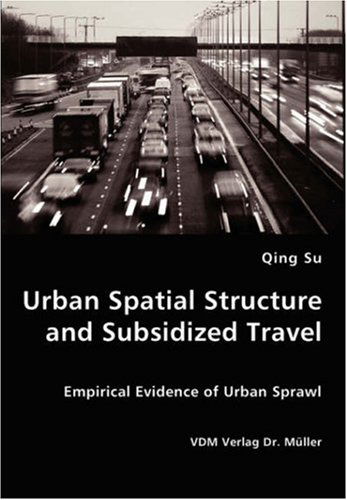
Urban Spatial Structure and Subsidized Travel
Qing Su
Revision with unchanged content. The last half of the twentieth century has witnessed an accelerated growth of suburbs within the urban areas as Americans moved to new homes on the fringes of metropolitan areas. It is also true that U. S. travelers have never paid the full cost of their travel. What is the relationship between these two phenomena? In 2000, all levels of U. S. government provided a $46.5-billion subsidy to highway users. That motorists were subsidized at 36.5 percent of total highway expenditures was not an anomaly. The public transit users were subsidized at 74 percent. When users do not pay the full cost of their travel, they have an incentive to travel greater distances and make more frequent trips, which may contribute to excessive urban expansion. This book provides both theoretical and empirical analysis to answer two questions: (1) Is there causal relationship between transportation subsidies and suburbanization? (2) Do the subsidies provided to highway users and transit users play the same role in urban expansion? The book is addressed to professionals in urban and transportation planning fields. It is also directed towards researchers in urban and regional economics, environmental economics, urban planning, and social ecology.
| メディア | 書籍 Paperback Book (ソフトカバーで背表紙を接着した本) |
| リリース済み | 2007年12月11日 |
| ISBN13 | 9783836434416 |
| 出版社 | VDM Verlag Dr. Mueller e.K. |
| ページ数 | 172 |
| 寸法 | 150 × 220 × 10 mm · 281 g |
| 言語 | 英語 |





![Cover for Miguel Ángel Gómez · Consumer Behaviour in an Online Shopping Environment (Paperback Book) [Spanish edition] (2008)](https://imusic.b-cdn.net/images/item/original/923/9783639094923.jpg?miguel-angel-gomez-2008-consumer-behaviour-in-an-online-shopping-environment-paperback-book&class=scaled&v=1444140415)