この商品を友人に教える:
High Angular Resolution Studies of the Structure and Evolution of Protoplanetary Disks Joshua A. Eisner
遠隔倉庫からの取り寄せ


High Angular Resolution Studies of the Structure and Evolution of Protoplanetary Disks
Joshua A. Eisner
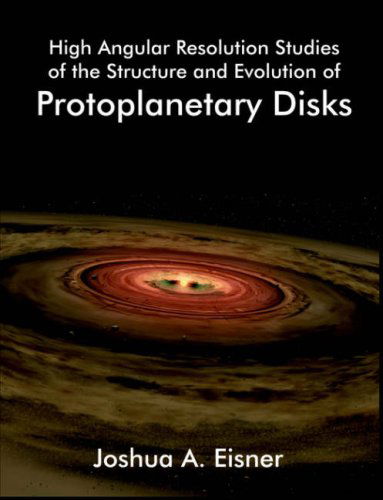
Young stars are surrounded by massive, rotating disks of dust and gas, which supply a reservoir of material that may be incorporated into planets or accreted onto the central star. In this dissertation, I use high angular resolution observations at a range of wavelengths to understand the structure, ubiquity, and evolutionary timescales of protoplanetary disks. First, I describe a study of Class I protostars, objects believed to be at an evolutionary stage between collapsing spherical clouds and fully-assembled young stars surrounded by protoplanetary disks. I use a Monte Carlo radiative transfer code to model new 0.9 micron scattered light images, 1.3 mm continuum images, and broadband spectral energy distributions. This modeling shows that Class I sources are probably surrounded by massive protoplanetary disks embedded in massive infalling envelopes. For the best-fitting models of the circumstellar dust distributions, I determine several important properties, including envelope and disk masses, mass infall rates, and system inclinations, and I use these results to constrain the evolutionary stage of these objects. Second, I discuss observations of the innermost regions of more evolved disks around T Tauri and Herbig Ae/Be stars, obtained with the Palomar Testbed and Keck Interferometers. I constrain the spatial and temperature structure of the circumstellar material at sub-AU radii, and demonstrate that lower-mass stars are surrounded by inclined disks with puffed-up inner edges 0.1-1 AU from the star. In contrast, the truncated inner disks around more massive stars may not puff-up, indicating that disk structure depends on stellar properties. I discuss the implications of these results for disk accretion, terrestrial planet formation and giant planet migration. Finally, I put these detailed studies of disk structure into a broader context by constraining the mass distribution and evolutionary timescales of circumstellar disks. Using the Owens Valley Millimeter Array, I mapped the millimeter continuum emission toward >300 low-mass stars in the NGC 2024 and Orion Nebula clusters. These observations demonstrate that the average disk mass in each cluster is comparable to the "minimum-mass protosolar nebula," and that there may be disk evolution on one million year timescales.
| メディア | 書籍 Paperback Book (ソフトカバーで背表紙を接着した本) |
| リリース済み | 2005年6月25日 |
| ISBN13 | 9781581122800 |
| 出版社 | Dissertation.Com. |
| ページ数 | 240 |
| 寸法 | 186 × 13 × 242 mm · 435 g |
| 言語 | 英語 |