この商品を友人に教える:
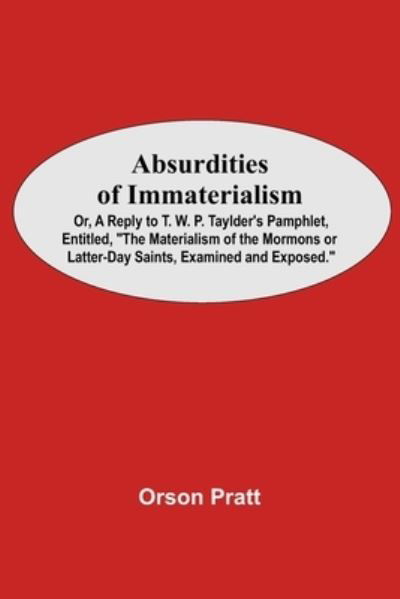
Absurdities of Immaterialism Orson Pratt
遠隔倉庫からの取り寄せ
 クリスマスプレゼントは1月31日まで返品可能です



他の形態でも入手可能:
Absurdities of Immaterialism
Orson Pratt
What does this author mean by the foregoing assertions? Does he mean, that no truth was understood by the Grecian and Roman schools? That no truth was discerned by the nations, during the first four thousand years after the creation? Or, does he mean, that the gospel truths were not understood until they were revealed? He certainly must mean the latter and not the former. Both the Romans and Grecians could, without the least difficulty, answer the question. "What is truth?" Nothing is more simple than an answer to this question. It is a truth, that something exists in space, and this truth was just as well perceived by all nations before the book called the New Testament existed as afterwards. It is a truth that, "the three angles of a triangle are equal to two right angles." This was not learned from that sacred book-the Bible. We admit that the question, what is gospel truth, could not be answered by any one to whom the gospel had never been revealed. Dr. Good, in his "Book of Nature," says, "general truth may be defined, the connexion and agreement, or repugnancy and disagreement, of our ideas." This definition we consider erroneous; for it makes general truth depend on the existence of ideas. Now truth is independent of all ideas. It is a necessary truth that, space is boundless, and that duration is endless, abstract from all connexion and agreement of our ideas, or even of our existence, or the existence of any other being. If neither the universe nor its Creator existed, these eternal unchangeable, and necessary truths would exist, unperceived and unknown. Truth is the relation which things bear to each other. Knowledge is the perception of truth
| メディア | 書籍 Paperback Book (ソフトカバーで背表紙を接着した本) |
| リリース済み | 2017年4月21日 |
| ISBN13 | 9781545081303 |
| 出版社 | Createspace Independent Publishing Platf |
| ページ数 | 66 |
| 寸法 | 152 × 229 × 4 mm · 99 g |
| 言語 | 英語 |



![Cover for Orson Pratt · A Series of Pamphlets on the Doctrines of the Gospel (Paperback Book) [Deseret Alphabet edition] (2015)](https://imusic.b-cdn.net/images/item/original/535/9781511599535.jpg?orson-pratt-2015-a-series-of-pamphlets-on-the-doctrines-of-the-gospel-paperback-book&class=scaled&v=1504442599)