この商品を友人に教える:
Substantial Substrata vs. Insubstantial Substrata Edward N. Haas
遠隔倉庫からの取り寄せ


Substantial Substrata vs. Insubstantial Substrata
Edward N. Haas
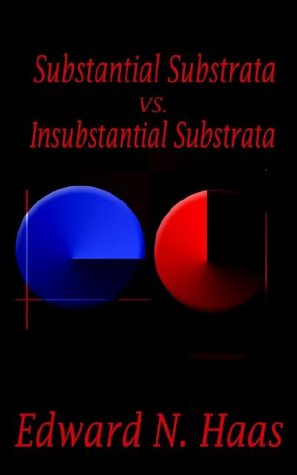
Imagine a smooth, solid glass sphere four inches in diameter in your right hand. It's mostly transparent but tinted blue. Imagine another tinted red in your left hand. From of old, many have said each of those spheres is a bundle of the substratum 'matter', and each is a separate thing because it is not stuck either to the other globe or to your hand or to any other bundle of matter. They then contrasted each globe's internal characteristics with its substratum. The latter, they said, can avoid annihilation without being stuck to something else. The former cannot. For example, the blue globe does not have to cohere to the red globe or to your hand in order for its matter to avoid disappearing. Shatter either globe, and, instantly, its spherical shape vanishes. Say some substratum can avoid annihilation without being bonded to some other substratum, and you call it substantial. Say it can't, and you call it insubstantial. Say all substrata are substantial, and there's only one way to explain the relationship between the glass globes you see and their ultimate sub-atomic particles. You must say each globe's ultimate particles are its only matter, since only they fit the definition of 'substantial'. That makes it impossible to account for the internal characteristics we sense in the globes. For, those characteristics are wholly unlike the ones found in what you have proclaimed the only pieces of matter in the globes. But, if the internal characteristics sensed are not the internal characteristics of the only matter you acknowledge, then of what are they the internal characteristics? Nothing?! So many have despairingly concluded. Say some substrata are insubstantial, and you'll describe that relationship very differently. You'll say each globe's matter is something, repeatedly produced by, cohering to, and filling the gaps between, those ultimate particles. It's then easy to explain the globe's sensible characteristics. For, you've introduced a new kind of matter which may
| メディア | 書籍 Paperback Book (ソフトカバーで背表紙を接着した本) |
| リリース済み | 2002年8月22日 |
| ISBN13 | 9781403339591 |
| 出版社 | AuthorHouse |
| ページ数 | 320 |
| 寸法 | 125 × 18 × 200 mm · 349 g |
| 言語 | 英語 |






![Cover for Edward N. Haas · The Story of Drawden the Pig (Paperback Book) [May edition] (1999)](https://imusic.b-cdn.net/images/item/original/610/9781585002610.jpg?edward-n-haas-1999-the-story-of-drawden-the-pig-paperback-book&class=scaled&v=1410085749)